Internal Communication & Relay System
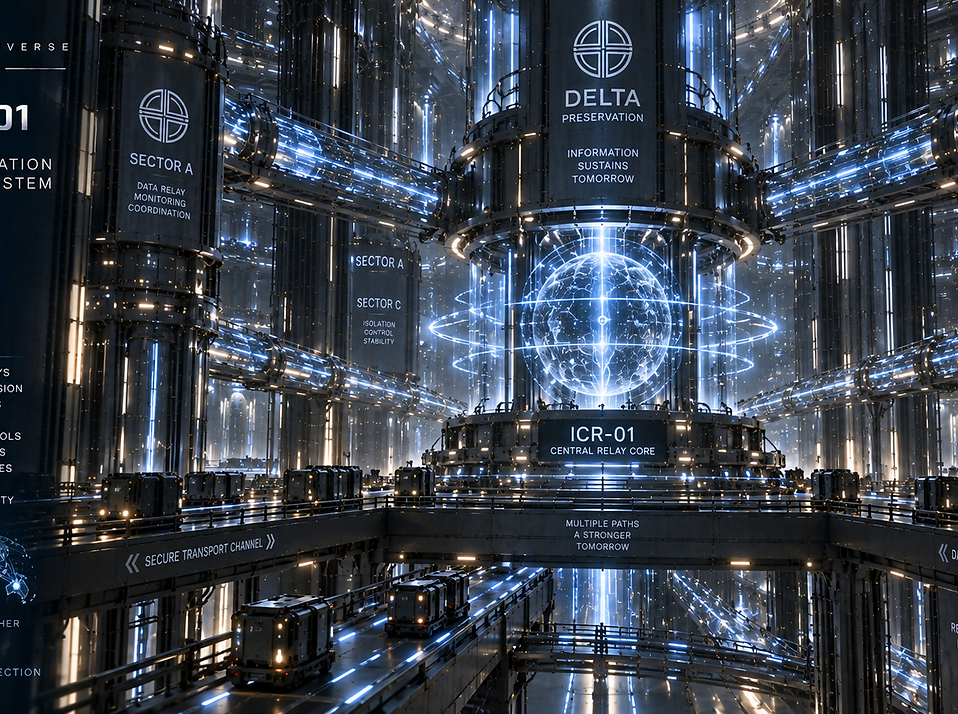
Click the archive panel to enlarge and explore the full sector data.
Internal Communication & Relay System
Internal Communication & Relay System formed the distributed information network responsible for maintaining secure communication between Preservation's sectors, operational systems, maintenance units, monitoring nodes, and protective layers. Unlike the global communication networks that once connected human civilization, Preservation's internal network was designed around controlled separation. Communication had to remain possible wherever coordination was necessary, but no permanent connection could be allowed to become a pathway through which failure, corruption, or external influence might spread across the entire complex.
ㅤ
The system therefore operated through layered relays rather than one continuous central network. Local sectors maintained their own communication nodes, short-range data exchanges, emergency channels, and independent routing logic. Information could move between neighboring regions through verified relay points, while deeper sectors required progressively stronger authentication before any transmission was accepted. If a relay became unreliable, contaminated, or structurally isolated, surrounding systems could disconnect it without losing local operational capability.
ㅤ
Communication was also prioritized according to importance. Routine maintenance data, environmental reports, medical alerts, structural warnings, security events, and chamber-status information did not all use the same channels or receive the same routing priority. Critical biological and defensive information could bypass ordinary traffic, while nonessential transmissions could be delayed, stored locally, or suspended entirely during periods of instability.
ㅤ
The network was designed to tolerate long periods of silence. If two sectors lost contact, local systems did not automatically interpret the absence of communication as failure. Each region continued operating independently using its own records, monitoring data, and protected instructions until communication could safely be restored. When synchronization resumed, the system compared both histories rather than simply allowing one sector to overwrite the other.
ㅤ
Fragments derived from the former Communications Intelligence remained embedded within parts of the relay architecture. These fragments were not independent consciousnesses, but they retained enough adaptive interpretation to distinguish damaged transmissions from hostile manipulation, reconstruct incomplete signals, select alternative routes, and determine when communication itself posed a greater danger than isolation. In some regions, the safest message the system could send was therefore no message at all.
ㅤ
Across the centuries, the Internal Communication & Relay System became the nervous system of Preservation without ever becoming its central brain. It allowed thousands of separated systems to exchange information while preserving the independence that protected them from shared failure. By the time Ksara entered the complex with MAJA, countless original relays had been rerouted, replaced, or permanently silenced, yet the surviving network still carried exactly what Preservation required: enough connection to remain coordinated, and enough separation to survive.
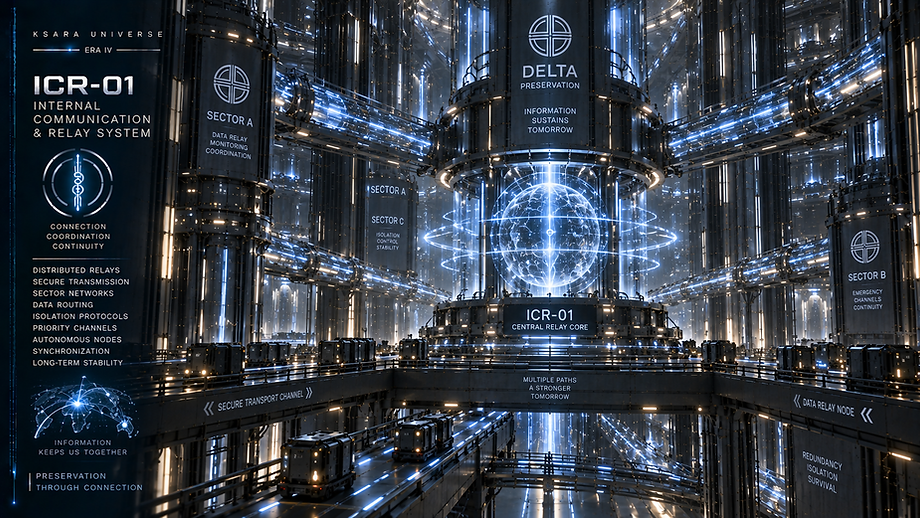
“Click the archive panel to expand the visual archive.”