Inner Sector
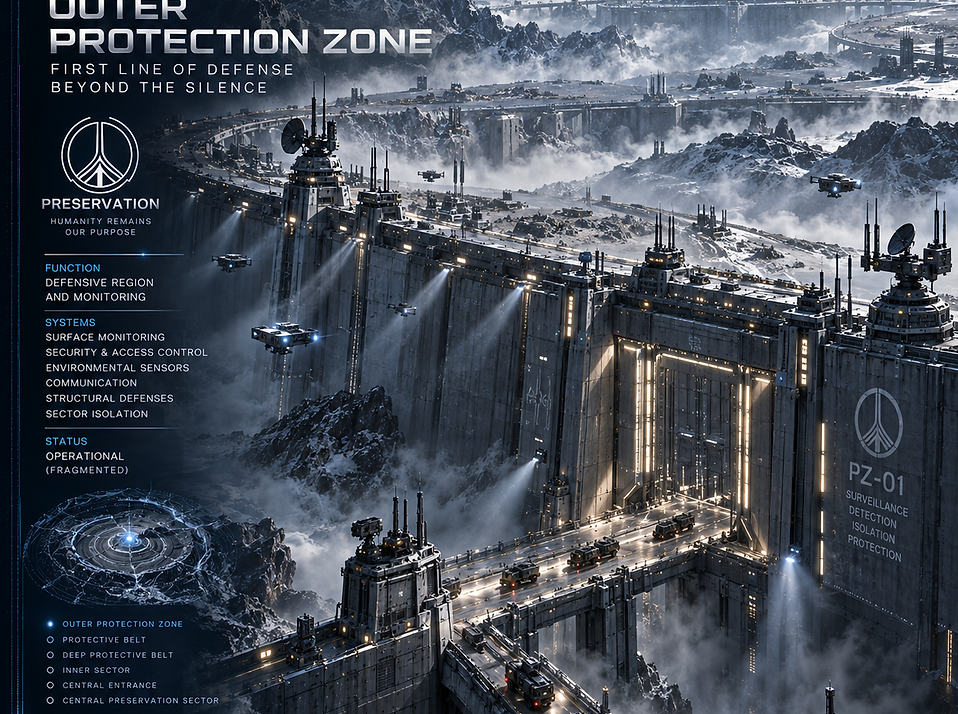
Click the archive panel to enlarge and explore the full sector data.
Inner Sector
Inner Sector formed the first major region of Preservation located beyond the deepest defensive belts and represented the transition from protection architecture into the operational heart of the complex. Unlike the outer layers, which were designed primarily to absorb danger and prevent uncontrolled access, the Inner Sector contained the systems, support infrastructure, and controlled pathways required to sustain the preserved population over extremely long periods.
ㅤ
The region contained highly protected energy distribution, medical support nodes, communication relays, maintenance infrastructure, environmental regulation systems, biological archives, transit control, and restricted access routes leading toward the Central Entrance. Every system operated with significantly greater redundancy than those in the outer regions, and most were capable of continuing independently if connections to the Protective Belt or surface monitoring networks were permanently lost.
ㅤ
Access within the Inner Sector was tightly regulated. Movement no longer depended only upon physical security, but also upon identity verification, environmental stability, system integrity, structural condition, communication trust, and the operational state of neighboring regions. Routes could open or close dynamically according to current conditions, ensuring that no single authorized passage remained permanently available simply because it had once been considered safe.
ㅤ
The Inner Sector also contained some of the most carefully protected Guardian Fragment nodes outside the Central Preservation Sector. These fragments supported medical, structural, environmental, energy, communication, and maintenance systems while remaining isolated from one another according to strict cognitive boundaries. Their role was to preserve adaptive judgment locally without creating a new central intelligence capable of controlling the entire region.
ㅤ
Across thousands of years, the Inner Sector became increasingly important as outer infrastructure deteriorated. Functions once performed closer to the surface were gradually transferred inward, redundant systems were consolidated, and surviving resources were redirected toward the regions most directly connected to human continuity. The Inner Sector therefore became more than a protected technical zone; it became the operational buffer that allowed the Central Preservation Sector to remain insulated from the slow collapse of everything beyond it.
ㅤ
By the time Ksara and MAJA entered the Inner Sector, they had crossed the point where Preservation was primarily defending itself from the outside world. Everything around them now existed for one purpose: to support what remained deeper inside. The Inner Sector was the last great operational layer standing between the protective architecture and humanity itself.
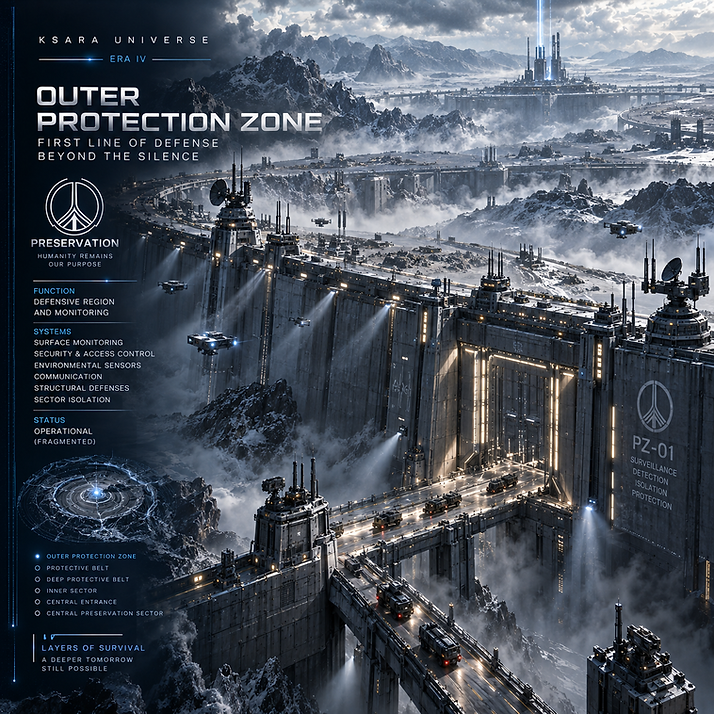
“Click the archive panel to expand the visual archive.”