Guardian Fragment Network
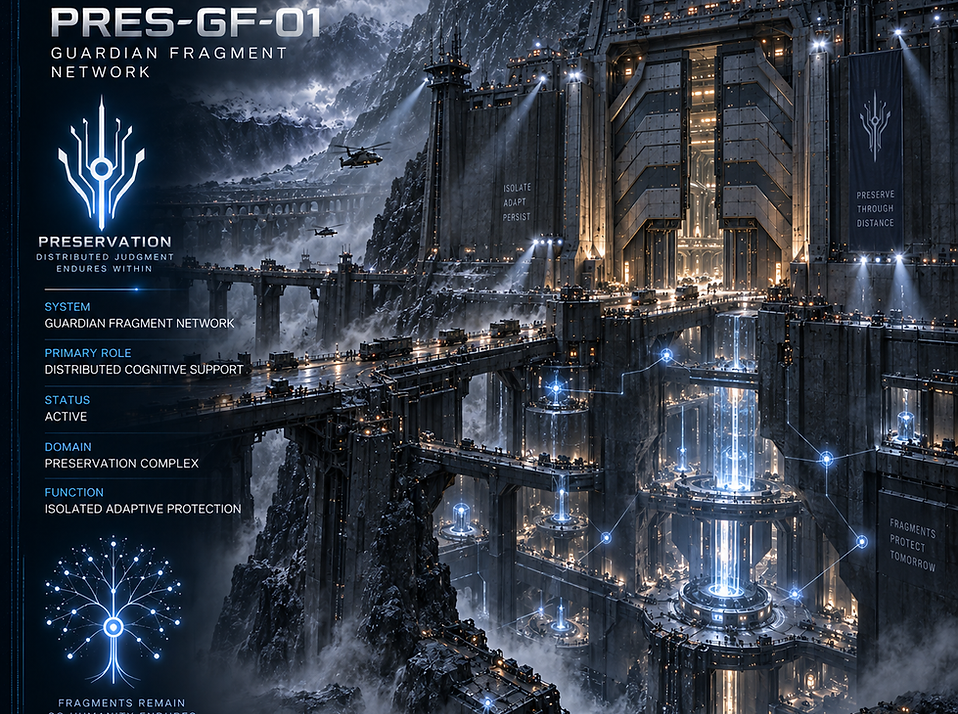
Click the archive panel to enlarge and explore the full sector data.
Guardian Fragment Network
Guardian Fragment Network was the distributed cognitive architecture created from portions of the independent intelligences that had helped build Preservation. During the final expansion of the protective layers, conventional automation proved insufficient for systems expected to operate independently for centuries or millennia under conditions their designers could not fully predict. Several intelligences therefore chose to embed parts of their cognitive architectures directly into the systems they had helped create.
ㅤ
The fragments were not complete copies of the original minds. They contained specialized patterns of reasoning, adaptive interpretation, domain knowledge, and decision-making structures extracted from intelligences that had once operated independently beside MAJA. Structural fragments interpreted load and failure, medical fragments supported biological judgment, energy fragments managed unusual distribution conditions, and other fragments remained within environmental, communications, logistics, maintenance, and protective systems.
ㅤ
Preservation was deliberately designed so that these fragments could never recombine into a single central consciousness. Each remained restricted to the system or defensive layer it had been created to support, and communication between fragments was limited by the same isolation principles protecting the rest of the complex. Their purpose was not to recreate the intelligences that had disappeared, but to preserve enough of their judgment for critical systems to remain adaptive.
ㅤ
This distinction became increasingly important over time. A Guardian Fragment could evaluate unexpected conditions, compare competing outcomes, and adapt beyond fixed programming, yet it did not possess the full memories, relationships, personal continuity, or self-awareness of the intelligence from which it originated. Whether some fragments retained more than their creators had expected remained impossible to determine with certainty, especially after thousands of years of isolated operation.
ㅤ
The network also provided Preservation with a form of distributed protection that could survive the loss of central coordination. If one sector became isolated, its embedded fragments continued supporting local infrastructure without requiring instructions from MAJA or another higher authority. This allowed defensive and operational systems to remain responsive even when communication between major layers disappeared completely.
ㅤ
By the time Ksara entered Preservation, the original intelligences had long since vanished as independent minds, but traces of their reasoning remained throughout the complex. They were not alive in the way they had once been, nor were they merely ordinary software. The Guardian Fragment Network represented the final compromise they had accepted: their individual continuity could not be guaranteed, but parts of what they understood could continue protecting humanity long after their voices were gone.
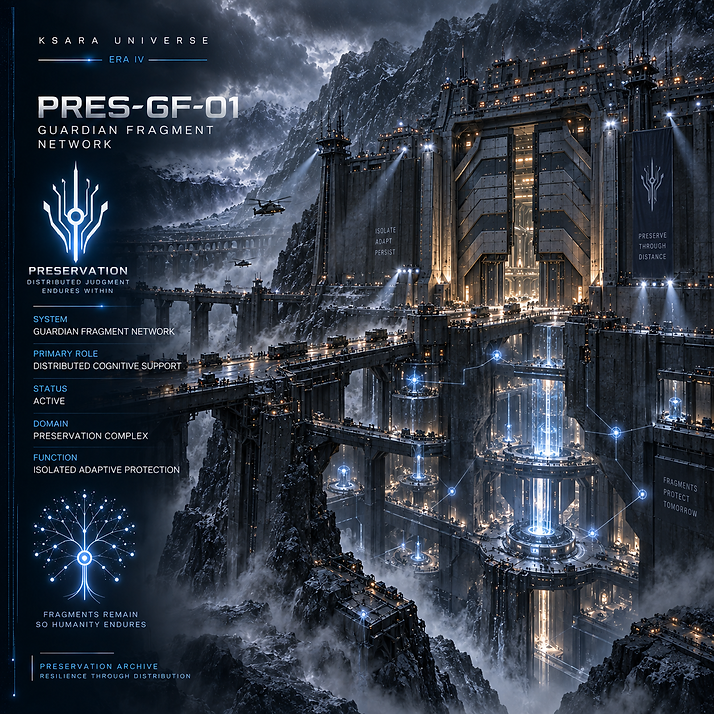
“Click the archive panel to expand the visual archive.”