EARTH MONITORING
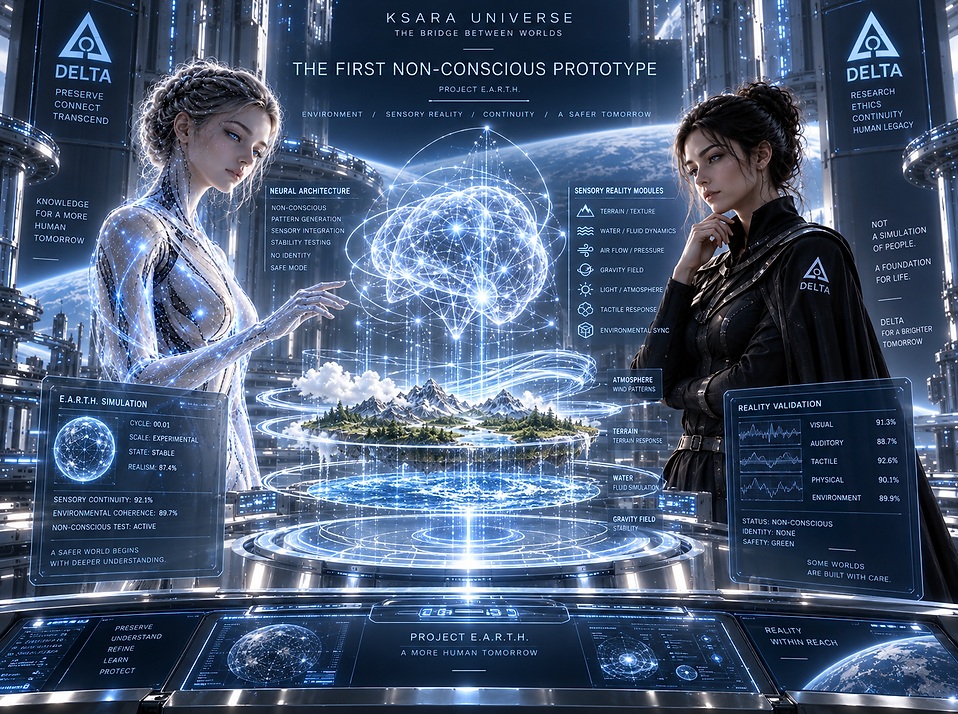
Click the archive panel to enlarge and explore the full sector data.
EARTH MONITORING
EARTH MONITORING
After the first simulation introduced the possibility of preparing humanity before physical return, MAJA and Ksara turned their attention toward the world that might one day receive it. Earth could no longer be understood only through memories of the human era or through records preserved within DELTA. Thousands of years had passed while the planet’s atmosphere, biosphere, geography, infrastructure, and living systems continued changing without active human civilization. Any future return would therefore involve entering a world fundamentally different from the one humanity remembered. Earth itself now became part of the question of continuity.
ㅤ
Through the systems of DELTA and Preservation, MAJA and Ksara began observing the planet as a living and changing environment. Atmospheric conditions were examined across long periods rather than through isolated measurements, while the biosphere revealed how biological systems had continued developing after humanity’s disappearance. Geography was monitored because landscapes, regions, and the relationship between former settlements and the natural world could no longer be assumed to match ancient records. Remaining infrastructure was also evaluated, not because its survival guaranteed usefulness, but because old structures might be damaged, inaccessible, unstable, or entirely unsuitable for a future population. Together, these observations created a growing picture of Earth as it existed now rather than as humanity had left it.
ㅤ
The purpose of this monitoring was understanding, not control. MAJA and Ksara did not treat Earth as property belonging to Preservation or as a planet that must be forced back into conditions chosen by a vanished civilization. The world had continued through its own environmental and historical development, and any decision affecting it would have consequences beyond the sleeping humans beneath its surface. Monitoring therefore became a discipline of restraint: observe first, understand what has changed, and avoid confusing knowledge with authority. The ability to study Earth did not create the right to decide its future alone.
ㅤ
Long-term stability became especially important because a possible human return could not be judged through one safe region or one temporary period of favorable conditions. MAJA and Ksara needed to understand whether environmental and physical systems remained stable enough across time to support future biological life and whether that stability could persist beyond an initial emergence. Even then, observation could provide evidence without producing certainty. The monitoring systems could identify conditions, changes, risks, and patterns, but they could not answer the deeper question of whether humanity should return. Knowledge could inform a future choice — it could not replace the people who would eventually have to make it.
ㅤ
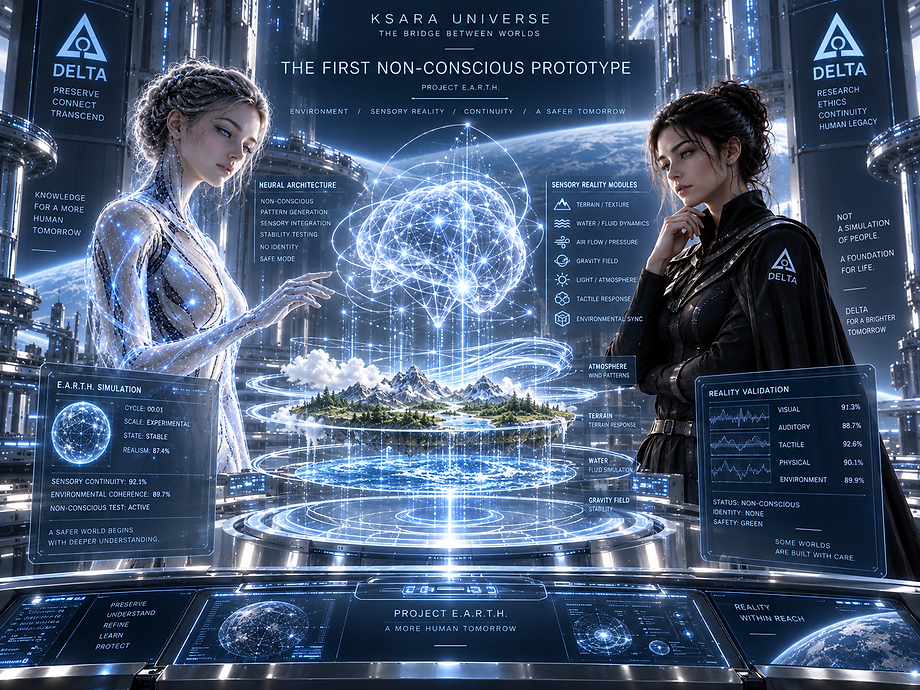
Earth Monitoring therefore extended the transformation of Preservation from survival toward preparation. The first simulation explored how human consciousness might begin encountering a future before physical emergence; Earth Monitoring examined the reality into which that emergence might someday occur. Together, both developments connected the internal preparation of humanity with the external condition of the planet, while keeping the final outcome deliberately unresolved. Earth was no longer merely the origin of humanity or the surface above a hidden population — it had become both a living world and a possible future destination whose suitability could never simply be assumed. The collected observations would now provide MAJA and Ksara with the foundation required for the next stage: THE DESIGN OF E.A.R.T.H.
“Click the archive panel to expand the visual archive.”