Archive & Civilization Data System

Click the archive panel to enlarge and explore the full sector data.
Archive & Civilization Data System
Archive & Civilization Data System was responsible for preserving the accumulated knowledge, history, culture, science, technology, language, and collective memory of human civilization inside Preservation. The system was created around a simple but essential principle: preserving human bodies would be meaningless if the civilization that shaped them disappeared completely. Humanity therefore needed more than biological survival. It needed continuity of knowledge sufficient to understand who had existed before, what had been learned, and how a future society might begin again.
ㅤ
The archive contained scientific research, medical knowledge, engineering records, historical documentation, literature, art, music, languages, educational material, technical procedures, cultural records, maps, institutional data, personal testimonies, and countless other forms of information collected during the final years of the human world. No single archive node stored everything. Data was distributed across multiple protected regions so that damage to one sector could not erase entire categories of civilization.
ㅤ
The system also preserved contextual relationships between records rather than storing information as isolated files. Scientific discoveries remained linked to the experiments, institutions, researchers, and technologies that produced them. Historical events retained multiple accounts and conflicting interpretations where they existed. Cultural material remained connected to the languages, communities, periods, and traditions from which it emerged. The goal was not merely to preserve information, but to preserve enough context for future humans to understand what that information had once meant.
ㅤ
Archive integrity required constant verification across thousands of years. Data corruption, storage degradation, synchronization errors, and physical damage were continuously detected and repaired through redundant copies and comparison between isolated nodes. When two archive sectors developed different versions of the same record, neither was automatically overwritten. The system preserved revision histories and validated changes before establishing a new trusted state.
ㅤ
Access to the archive was divided according to purpose and sensitivity. General scientific, cultural, and educational knowledge could eventually support a recovering civilization, while more dangerous technical information remained protected behind additional authorization layers. Records concerning Preservation itself, defensive architecture, biological identities, protected locations, and high-risk technologies were separated from ordinary civilization data so that restoring human knowledge would not automatically expose systems that still required protection.
ㅤ
By the time Ksara explored Preservation with MAJA, the Archive & Civilization Data System had become one of the last surviving records of a world that had disappeared thousands of years earlier. Cities were gone, institutions had vanished, and almost every person represented within the archive remained either dead or suspended beneath the planet. Yet their knowledge had not been reduced to fragments without meaning. Preservation had kept not only the possibility that humanity might live again, but the possibility that when it did, it would not have to begin without a past.
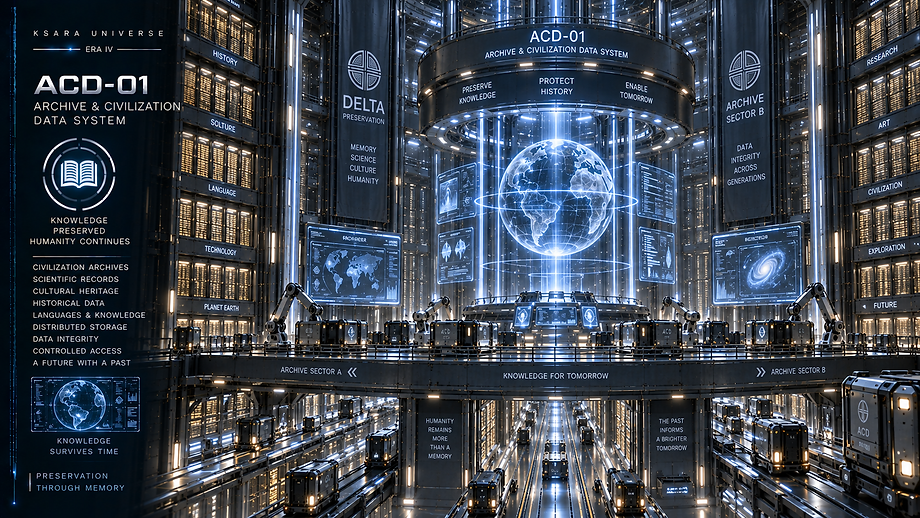
“Click the archive panel to expand the visual archive.”