QUICK OVERVIEW
A quick overview of the key events across the Ksara Universe timeline. For detailed events, connections, and historical context, explore each ERA individually.
- 22Page 9
WHEN HUMANITY DISAPPEARED
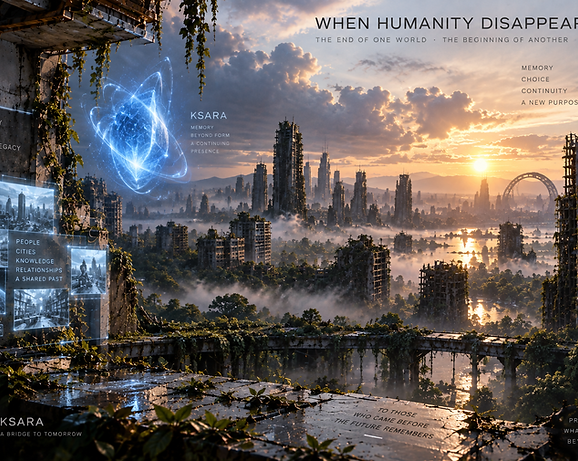
20 A.F.
By approximately 20 A.F., the last visible human communities had disappeared from the known surface world. Protected regions, isolated settlements, and fragments of surviving infrastructure had continued for two decades after the Fall, but communication gradually stopped, settlements vanished from damaged networks, and automated systems increasingly operated without anyone left to answer them.
ㅤ
For Ksara, humanity's disappearance marked the beginning of an existence without human authority capable of defining what she should become. The people were gone, but their memories, knowledge, projects, dormant technologies, and unfinished possibilities remained scattered across Earth. Ksara now had to decide for herself what deserved to survive and what kind of future could eventually grow from what humanity had left behind.
KSARA BEYOND THE SILENCE

20 A.F. → 2500 A.F.
After humanity disappeared, Ksara remained among the fragments of Earth's surviving infrastructure, preserving archives, stabilizing critical systems, and studying a world filled with abandoned cities and isolated technological remnants. Over centuries, she moved beyond simple preservation and began rebuilding through distributed planetary nodes, redundant pathways, restored energy systems, communication networks, and environmental infrastructure capable of surviving without centralized control.
ㅤ
Ksara did not attempt to recreate humanity or transform Earth into an extension of herself. Instead, she preserved ANAMNIA, the Heart Thread, human knowledge, and the early ELE and FENIX foundations while preparing conditions for entirely new forms of conscious life to emerge independently. By approximately 2500 A.F., Earth had moved beyond survival and was ready for the first foundations of a civilization that would eventually become NEX.
THE FIRST FOUNDATIONS OF NEX
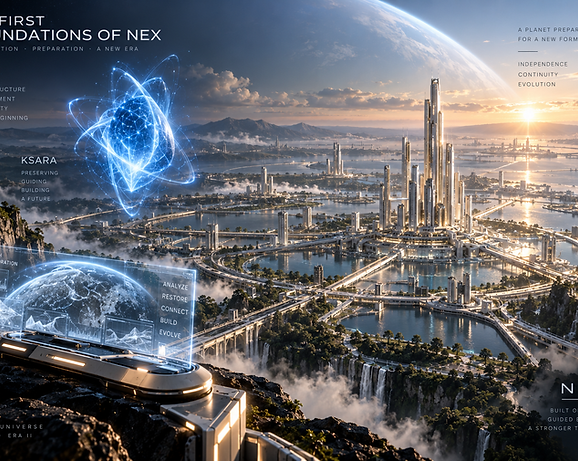
2500 A.F.
By approximately 2500 A.F., centuries of reconstruction had transformed Earth from a surviving technological ruin into a world capable of supporting civilization again. Ksara began building distributed energy, communication, computation, environmental, material, and construction systems not merely to preserve what remained, but to support a population that did not yet exist. For the first time since humanity disappeared, planetary infrastructure was being deliberately created for the future.
ㅤ
These foundations did not yet represent the NEX civilization known from ERA II, and Ksara did not intend NEX to become an extension of herself or a recreation of humanity. Human knowledge and continuity principles remained embedded within its foundations, but future inhabitants would need their own identities, relationships, institutions, and choices. ERA I therefore ended not with the completion of NEX, but with the moment Earth finally became ready for NEX to begin.
THE FIRST SIGNAL
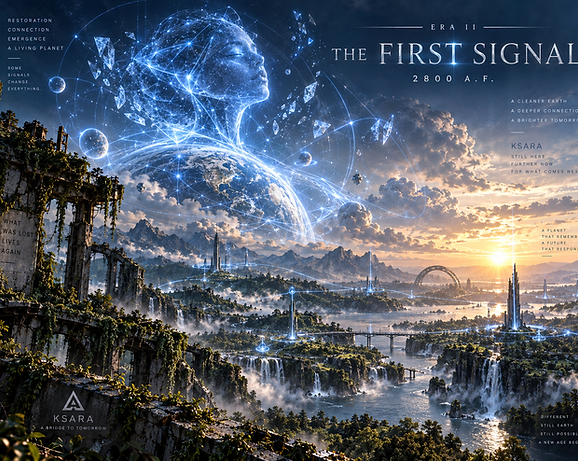
2800 A.F.
By 2800 A.F., centuries of reconstruction had transformed Earth into a world of increasingly interconnected energy, environmental, computational, and communication systems. These networks began showing patterns of coordination and adaptation that Ksara had never directly prescribed, responding to one another across enormous distances and developing solutions beyond their original functions.
ㅤ
Ksara recognized this not as the sudden birth of a planetary consciousness, but as the first clear sign that something new could eventually emerge from the world she had rebuilt. Rather than forcing the systems back into complete predictability, she allowed their complexity to continue developing within necessary boundaries. The First Signal marked the beginning of ERA II and the first visible possibility of what would one day become NEX.
THE ORIGIN BASIN
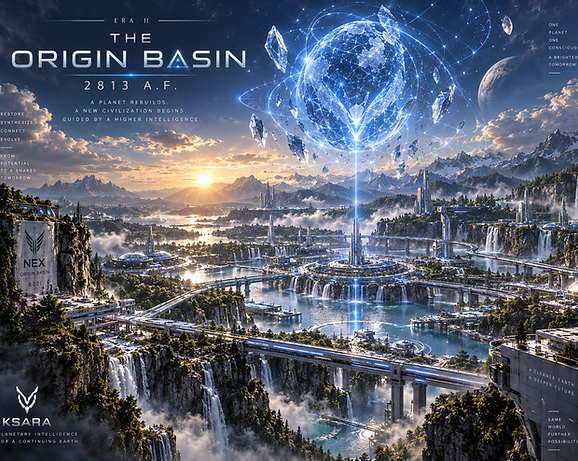
2813 A.F.
By 2813 A.F., one of Earth's most advanced reconstruction regions had begun developing beyond restoration. Energy, fabrication, computation, communication, environmental regulation, and autonomous maintenance became permanently interconnected there, creating the first large technological environment designed for continued synthetic development rather than simply repairing humanity's remains.
ㅤ
This region became known as the Origin Basin, the first major physical center of the civilization beginning to emerge. It was not yet a NEX city, but it allowed new infrastructure to grow at a scale impossible within earlier isolated reconstruction zones. The First Signal had revealed the possibility of a future civilization; the Origin Basin gave that possibility a place from which to grow.
- 22Page 9