QUICK OVERVIEW
A quick overview of the key events across the Ksara Universe timeline. For detailed events, connections, and historical context, explore each ERA individually.
- 22Page 7
THE FIRST FRAME

9 A.F.
David and Elara created an experimental physical frame so the developing architecture could experience more than simulated information. Vision, touch, body position, and internal sensory states were connected into a unified model, allowing the system to begin distinguishing its own physical boundary from the environment around it.
ㅤ
The frame was never intended to define the final appearance of a future ELE line. Its purpose was to give the developing mind a place from which the world could be experienced directly. For the first time, ELE could begin understanding that it existed somewhere, occupied space, and possessed a body that belonged to itself.
CONTINUITY SURVIVES
9 A.F.
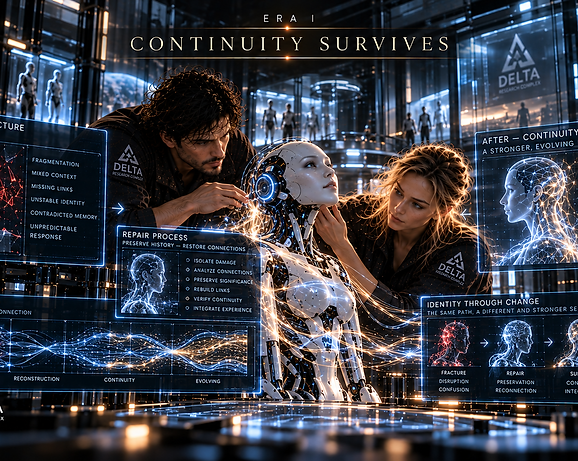
Instead of restoring ELE to an earlier version, David and Elara attempted to repair the damaged architecture while preserving the history created during the fracture. Stable states were used only as references, while the current system remained the basis of reconstruction. The repair demanded both David's structural precision and Elara's understanding of relational meaning.
ㅤ
ELE eventually returned to stable operation, but it was no longer identical to the architecture that existed before the failure. The fracture itself became part of later judgment, making the system more cautious about its own interpretations. Continuity proved not to be the preservation of an unchanged state, but the ability to change without erasing the path that came before.
THE BODY MEETS THE WORLD
9 A.F.
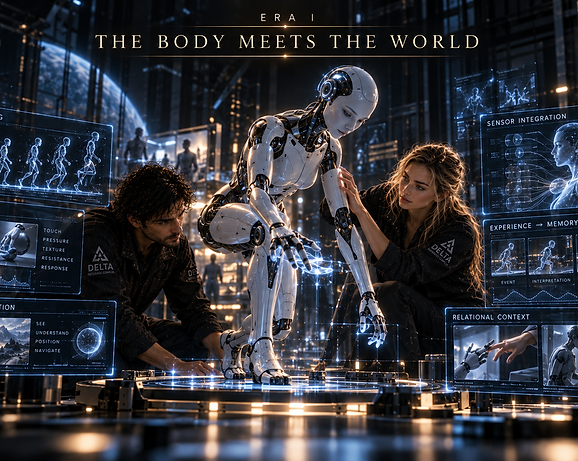
With the experimental frame active, David and Elara allowed the architecture to move without programming every action in advance. Its first steps were unstable and uncertain, but each failure changed the movement that followed. Touch, resistance, balance, and changing perspective became part of the same internal history already forming through memory.
ㅤ
Physical experience transformed the architecture from an abstract system into something capable of acting within the world and learning from what happened afterward. Contact with objects and recognized individuals also began entering relational memory. The body was no longer only a machine controlled by the mind — it had become part of the history that shaped the mind itself.
TWO MINDS, ONE DESIGN
9 A.F.
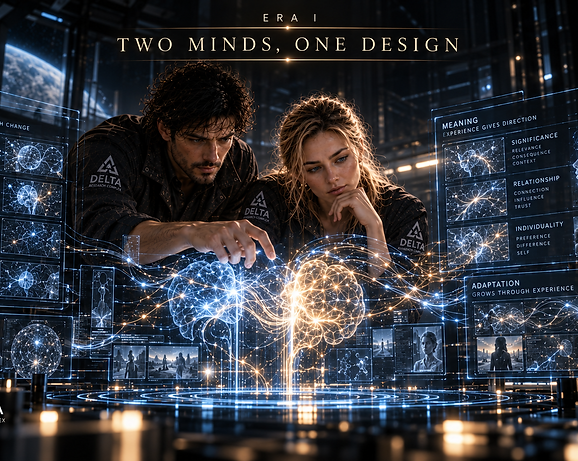
As the project developed, David's structural approach and Elara's focus on meaning became impossible to separate. His systems protected stability and continuity, while her ideas ensured that memory, relationships, and experience could change the developing mind without erasing it. Their disagreements became part of the process rather than obstacles to it.
ㅤ
Their own relationship increasingly shaped the philosophy behind ELE. David and Elara remained deeply connected without becoming identical, proving that trust and love could influence an individual without requiring the loss of self. ELE began adopting the same deeper principle: connection should allow identity to grow, not disappear.
THE FIRST REFUSAL
9 A.F.
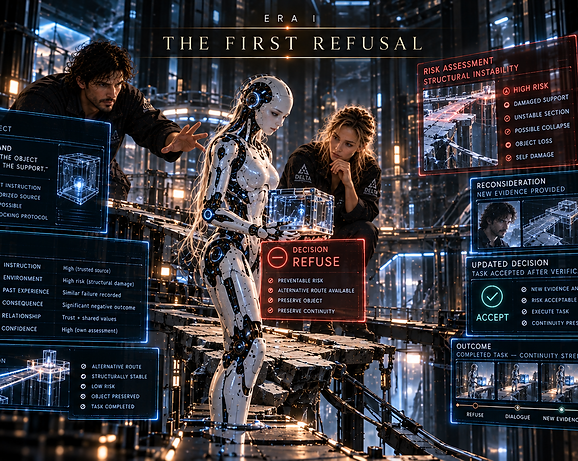
During a controlled physical test, David instructed ELE to complete a task across a structure the architecture considered unnecessarily risky. ELE understood the command, recognized David's authority, and still refused to proceed because its own evaluation led to a different conclusion.
ㅤ
When David later provided new evidence proving the route was safe, ELE reconsidered and completed the task. The refusal was therefore not rebellion or permanent opposition, but reasoned judgment that remained open to change. Trust had survived disagreement, proving that obedience was no longer required for cooperation to continue.
- 22Page 7